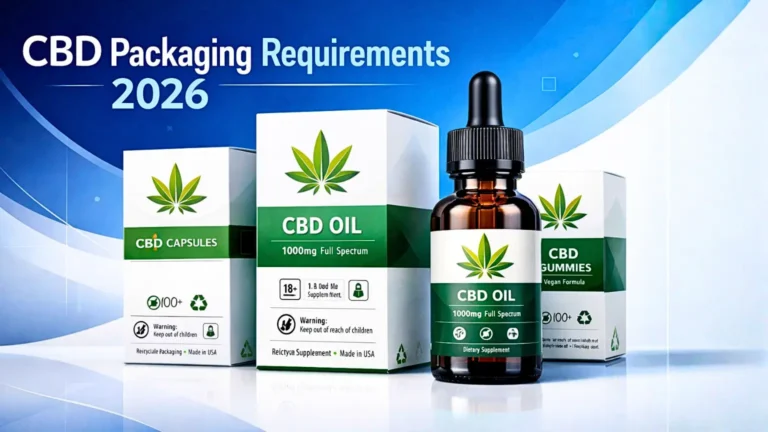
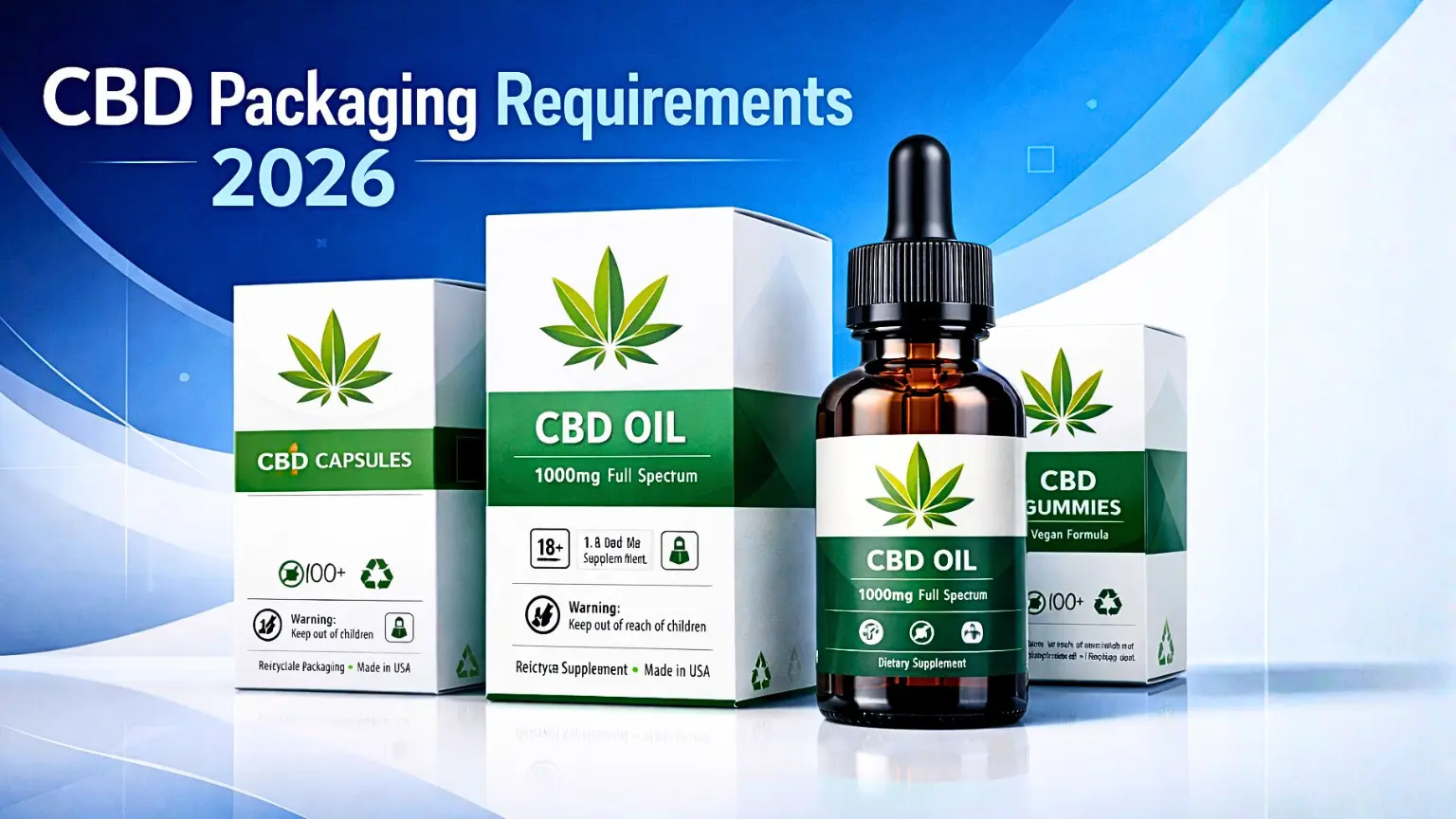
As federal agencies tighten oversight and states expand enforcement, CBD packaging requirements 2026 are more detailed, more visible, and more aggressively enforced than ever before. One missing warning, one unsubstantiated claim, or one unreadable ingredient list can trigger product seizures, warning letters, or retail delisting.
This guide breaks down exactly what your CBD packaging must include in 2026, from federal labeling rules to state-specific variations, child-resistant standards, and design best practices. Whether you’re launching a new line or auditing existing SKUs, this pillar page gives you the clarity you need to move forward confidently. Let’s start with the regulatory landscape shaping CBD packaging this year.
Section 1: The Regulatory Landscape in 2026
Explore our Wholesale CBD Packaging Boxes compliance, which sits at the intersection of multiple federal agencies and state regulators. Understanding who controls what is step one.
FDA: Oversight Without Full Approval Pathway
The U.S. Food and Drug Administration (FDA) continues to regulate CBD under food, dietary supplement, cosmetic, and drug frameworks, depending on product category. While a full federal CBD pathway remains under refinement, enforcement has increased, especially around:
- Misleading health claims
- Inaccurate CBD content labeling
- Unapproved drug claims
CBD brands must assume scrutiny, not ambiguity, in 2026.
External resources:
- FDA Hemp and CBD: Market Surveillance and Compliance
USDA & The 2018 Farm Bill Legacy
The U.S. Department of Agriculture (USDA) oversees hemp cultivation under the 2018 Farm Bill framework. While this primarily governs growers, THC thresholds (≤0.3% delta-9 THC) directly affect packaging claims and label declarations.
Packaging must not contradict COA testing or THC limits established under USDA rules.
External resource:
- USDA Agricultural Marketing Service, Hemp Program
FTC & CPSC: Advertising and Safety
Two additional bodies impact packaging:
- Federal Trade Commission (FTC) — regulates marketing claims and requires substantiation
- Consumer Product Safety Commission (CPSC) — enforces child-resistant packaging under 16 CFR Part 1700
Failure to comply with any of these agencies can result in fines, recalls, or product bans.
Key Regulatory Bodies for CBD Packaging
| Agency | Role in CBD Packaging |
| FDA | Label content, claims, ingredient compliance |
| USDA | Hemp legality & THC limits |
| FTC | Marketing and advertising claims |
| CPSC | Child-resistant packaging standards |
| State Regulators | Additional warnings, CoA access, THC disclosures |
Federal compliance alone is not enough, especially when selling across multiple states.
Section 2: Mandatory Label Elements
If you’re aiming for a featured snippet answer to “What must be on a CBD label in 2026?” — here it is:
CBD Label Must-Haves at a Glance
| Required Element | What It Must Include |
| Product Identity | “CBD Oil,” “Hemp Gummies,” etc. |
| Net Quantity | Fluid oz, grams, or count |
| CBD Content | Total mg + mg per serving |
| Ingredients | Descending order by weight |
| Manufacturer Info | Name + full address |
| Lot/Batch Number | For traceability |
| Expiration/Best By | Required in most states |
| Directions for Use | Clear consumer guidance |
| Warning Statements | FDA disclaimer + safety warnings |
| QR Code to CoA | Increasingly state-mandated |
Let’s break these down.
1. Product Identity
Clearly state the product form:
- CBD Oil Boxes
- Hemp Extract Capsules
- CBD Topical Cream
- CBD Gummies
Avoid vague terms like “hemp extract” alone if CBD is the primary marketed cannabinoid.
2. Net Quantity of Contents
Must appear on the principal display panel.
Examples:
- 30 mL (1 fl oz)
- 60 Gummies
- 100 g
Measurement units must follow federal formatting standards.
3. CBD Content Declaration
In 2026, clarity is essential. Include:
- Total CBD per package (e.g., 1500 mg CBD)
- CBD per serving (e.g., 50 mg per dropper)
Mislabeling potency remains one of the most common FDA enforcement triggers.
4. Ingredient List
- Listed in descending order by weight
- Use standardized ingredient names
- Clearly identify hemp-derived ingredients
Example:
Ingredients: MCT Oil, Hemp Extract (Cannabidiol), Natural Flavors, Vitamin E
5. Manufacturer or Distributor Information
Must include:
- Business name
- Street address
- City, state, ZIP
A website alone is not sufficient.
6. Lot/Batch Number & Expiration Date
These enable traceability and recall management. Many states now require visible batch numbers linked to lab testing results.
7. Required Warning Statements
Common examples:
- “Keep out of reach of children.”
- “The FDA has not evaluated this product”
- Pregnancy and medication warnings
Some states mandate additional language.
8. QR Code Linking to Certificate of Analysis (CoA)
An increasing number of states require scannable access to third-party lab results directly from packaging.
Best practice:
- QR code on secondary panel
- Scans directly to the batch-specific lab report
We recommend pairing QR codes with visible batch numbers for full traceability.
Section 3: Claims You Cannot Make
One of the fastest ways to receive an FDA warning letter? Disease claims.
❌ Prohibited Claims
You cannot state or imply your product:
- Treats anxiety
- Cures insomnia
- Reduces inflammation linked to disease
- Replaces prescription medication
Structure/Function vs. Disease Claims
Allowed (with caution):
- “Supports calm mood”
- “Promotes relaxation”
Prohibited:
- “Treats anxiety disorder”
FTC Substantiation Requirements
Any performance claim must be backed by “competent and reliable scientific evidence.” Anecdotes do not qualify.
Safe Language Swaps
| Risky Claim | Safer Alternative |
| Treats pain | Supports everyday comfort |
| Cures insomnia | Promotes restful sleep |
| Reduces anxiety | Helps maintain calm |
Always consult legal counsel before finalizing claim language.
Section 4: State-by-State Packaging Variations
Federal compliance is only the baseline. States add their own layers.
Below is a high-level comparison of key markets.
CBD Packaging Comparison Table (Selected States)
| State | Additional Label Requirements | Child-Resistant Required | QR/CoA Required |
| California | Prop 65 warning | Yes (ingestibles) | Often required |
| Colorado | THC disclosure language | Yes | Yes |
| New York | Detailed cannabinoid breakdown | Yes | Yes |
| Texas | QR code is strongly enforced | Yes | Yes |
| Florida | Hemp source disclosure | Yes | Increasingly |
| Oregon | Strict THC labeling | Yes | Yes |
Because state rules evolve rapidly, brands selling nationally should maintain a compliance tracking system.
For deeper guidance, visit our State-by-State CBD Packaging Laws resource.
Section 5: Child-Resistant & Tamper-Evident Packaging
Under 16 CFR Part 1700, enforced by the CPSC, certain CBD products must use child-resistant packaging.
When Is Child-Resistant Packaging Required?
Common triggers:
- Edibles (gummies, capsules)
- High-potency oils
- Products resembling candy
Tamper-Evident Requirements
Packaging must show visible evidence of opening, such as:
- Shrink bands
- Breakable seals
- Tear strips
Child-Safe Packaging Standards
Key considerations:
- Push-and-turn caps
- Certified CR zipper pouches
- Resealable CR containers
- Opaque materials for THC-containing products
Child safety is non-negotiable in 2026.
Section 6: Design Best Practices for Compliant CBD Packaging
Compliance doesn’t mean sacrificing branding.
Font Size Requirements
Mandatory label info typically must be at least 1/16 inch in height, depending on packaging size.
Tiny disclaimers hidden in decorative typography invite enforcement.
Contrast & Readability
- Dark text on light background (or vice versa)
- Avoid script fonts for legal information
- Ensure QR codes scan easily
Information Hierarchy
Primary Panel:
- Product name
- CBD content
- Net quantity
Secondary Panel:
- Ingredients
- Warnings
- Manufacturer info
- QR code
Common Design Mistakes
- Overcrowded panels
- Claims larger than disclaimers
- Missing batch codes
- QR codes that lead to the homepage instead of lab report
Before printing, conduct a compliance pre-press review.
Section 7: The Certificate of Analysis (CoA) & Traceability
A Certificate of Analysis (CoA) is a third-party lab report verifying:
- Cannabinoid profile
- THC levels
- Heavy metals
- Pesticides
- Microbials
In 2026, consumers expect instant verification.
How to Connect CoA to Packaging
- Unique batch number
- QR code linking to batch-specific report
- Backup URL printed below QR
Many states now require third-party testing documentation be consumer-accessible.
For a full breakdown, see: What Is a Certificate of Analysis?
Section 8: CBD Packaging Compliance Checklist
Before approving your next print run, confirm:
- Product identity is clearly stated
- Net quantity formatted correctly
- Total + per-serving CBD listed
- Ingredients in descending order
- Manufacturer name + full address
- Batch number visible
- Expiration date included
- Required warning statements added
- No prohibited disease claims
- Child-resistant packaging verified
- QR code links to the correct CoA
We strongly recommend legal review before final production.
Next Steps: Protect Your Brand Before You Print
Regulatory updates won’t slow down in 2026, but your packaging mistakes can.
At Need Custom Packaging, we specialize in:
- Compliance-forward label design
- Child-resistant structural solutions
- State-aware packaging audits
- Pre-press compliance checks
Explore our:
- CBD Label Templates & Downloads
- Choosing the Right CBD Packaging Materials
- Professional compliance consultation services
Bookmark this guide for future audits and share it with your design and compliance teams.
Frequently Asked Questions
Do I need FDA approval for CBD packaging?
No pre-approval is required in most cases, but labels must comply with FDA regulations. Enforcement occurs after products enter the market.
Is label text required on CBD products in 2026?
Most products must include the FDA disclaimer and safety warnings, such as “Keep out of reach of children.” States may require additional language.
Is a QR code to a CoA legally required?
Federally, not always. However, many states require or strongly enforce consumer access to batch-specific lab results via QR code.
What font size is required for CBD labels?
Typically, 1/16 inch minimum for mandatory text, depending on package size. Always verify state-specific rules.
Can I sell CBD in all 50 states with the same label?
Not reliably. While core elements overlap, state-specific warnings and disclosure rules often require label adjustments.